
The Artist's Studio
Is an artist's studio essential? I think we all need a space to create. Where is your space?

In search of a space
I’ve been reflecting on the importance of an artist’s studio. Although I readily accept I have called this newsletter/blog ‘Tales from the Art Shed’, I sometimes refer to my space as a ‘studio’. But, in the same way I still feel uncomfortable calling myself an ‘artist’ (like when I first called myself a ‘writer’ years ago), I feel a bit of a ponce, so until I win the Turner Prize it’ll be a shed. Imposter syndrome could be a whole other post so we’ll park that there.
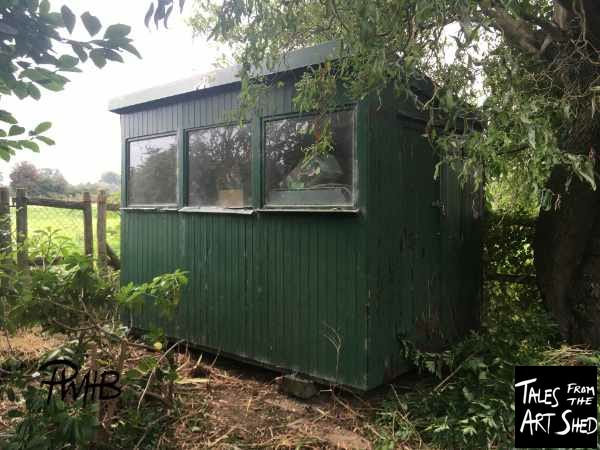
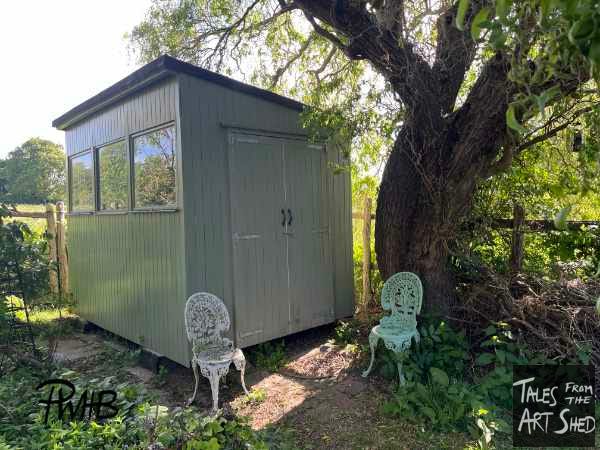
I’m proud of my little shed because getting it to a state I could work in was a labour of love and seemed a million miles from the rotting husk I found at the bottom of the garden the day I moved in. I had remembered peering through a hole in the cladding while the estate agent falsely claimed it had power but that the owner hadn’t left any keys. I had to take his word for it. Convenient. When I did finally prize the rusty padlock open and wrenched the double doors apart I was assaulted by the smell of mould and damp. The roof had been leaking for years, the cable once supplying power had been cut long ago, and most of the cladding including the floor (my foot went through it) and doors were rotten. And to be honest, back then five or so years ago, I hadn’t really cared because the notion I might embrace my old love of art and become a ‘second career’ artist had not occurred to my post-Covid brain. I would not even have considered it for writing either because luckily there was a spare room in the house that could serve that purpose. And so it remained unloved until, not many months later, my mum passed away, and in the year of grieving (it was years in the end), when I had taken up art again, I eyed up the shed at the bottom of the garden to renovate. And anyway, I needed a physical project that would take my mind off the pain.
I didn’t dare tell anybody I was hoping it could become an art studio because that felt too serious; taking art seriously seemed crazy. I’d only just started out and was still learning (you never stop), and anyway, I would probably get bored of it and find some new obsession, I assumed. But I could feel this new passion taking hold like a fever. Was I secretly cheating on my old love of writing?
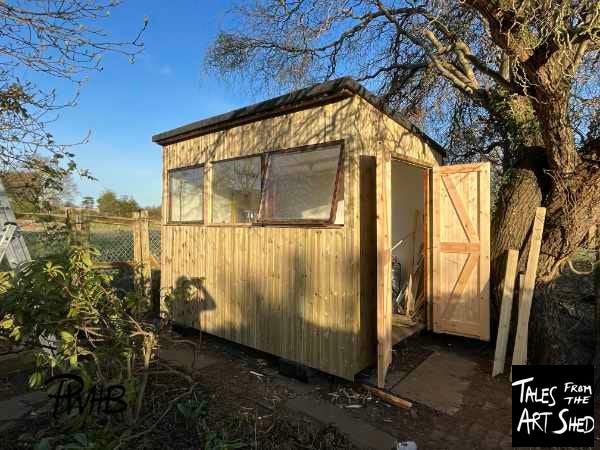
A year later, through snow, wind, rain and sun I had transformed the ugly duckling into a little green art studio with new cladding, power and heating, a patched-up roof and even a funky flip-up table with folding legs that I invented myself, for space efficiency (it’s been in the upright position ever since as I use it every day).
We all need a space to work, to think, to create. In a way, I never stop having a creative space to escape within — my head. I mean, when you’re an artist of any form you generally disappear a lot into your own head and daydream. You could be talking to someone and thinking about characters from your current novel or the exact tint of cerulean blue you want to blob on the canvas. While much of the creative thinking can obviously be done in your head, while cleaning the house or out for a walk, at some point a dedicated space is essential to make the work.
A physical space
When you finally want to attempt to drag that fizzy romantic idea out of your head and actually try and make it a tangible physical thing (the hard work bit) you need a space to create. I would say it’s absolutely fundamental for an artist to have some sort of space, be it a kitchen table, funky multi-purpose crafting table-come-cupboard, spare room, shed, garage or renting a purpose built art studio. I think this is true for other artists such as ceramicists, musicians, sculptors and many craftspeople, with perhaps the exception being writers or graphic designers or artists just working in the digital realm who might just get away with a laptop on a train or in a cafe. Although, when I was a professional writer, even though I would occasionally work remotely on a laptop, I always needed a room to work in, with a comfy chair, music on tap, my reference books around me, noticeboards for ideas and plotting, etc. Sorry if I’ve missed out any creatives but I think you get the idea.
If you’re a visual artist you’re gonna need room for paintbrushes and paint and paper and canvas stretchers and canvas rolls and materials and jars and tables and easels and any other specific paraphernalia that enables you to do your art, like a printing press or pottery wheel. I also like to work on multiple pieces at once and have space to dry them — oh and some wall space to pin up things to admire / destroy later.
A work space
If you have a space you signal to yourself and to other people that you are there working. And creativity is work. As Thomas Edison claimed that he once said, ‘Genius is one per cent inspiration, ninety-nine per cent perspiration.’ I used to say you need to ‘apply bum to seat’ in order to get a book written. I probably heard that somewhere but I know it’s true from bitter experience in my early writing days wandering around the house waiting for ‘the muse’ instead of just sitting at the computer and getting on with it.
You need to turn up and do the work, whether you’re writing a book, painting a picture, sculpting a figure or sewing a costume. And I think that a specific place of creativity just puts you in that, hopefully, distraction-free work zone.
(As an aside, obviously much of the pre-creative work can be done away from a creative space. I write the first drafts of these posts dictated on my phone on long car journeys — before you panic, it’s on hands-free! So, if you spot any savage and random digressions in these posts that’ll be why. In fact, for your amusement, here are some examples of my rantings when I’ve had to suddenly pay even more attention to the road: ‘...fuck no they got the big horses...’ or this long one that made me laugh and is reproduced verbatim: ‘...fuck on the wrong fucking way. I don’t know what’s going on honestly I don’t know what the fuck is going on. I’ve gone. I’ve gone really bad wrong oh shit what do I do? No, I think I’m on the right route. I just so confusing. It’s a three lane road here and it’s just gonna be a little bit of a mental mental kind of thing isn’t really here we go. I’m in the middle lane. Great this is just the one on the most confusing little bit of the journey but I’m all good. I’ve got green lights. I’m not speeding. I don’t think doing 40. It’s all good. There’s a big explode. Something is happening over there but that’s not cool. We’re on the right road...’ )
A safe space
Artists often use many materials that can be harmful to health like toxic paint pigments found in colours like cadmium red or, for the hardcore traditionalist (if you can get hold of it in your country), lead white! There are many mediums and liquids that artists use that contain volatile organic compounds (VOCs), dangerous fumes that have to be either extracted or wafted away through open windows. Plus, if you use various oils like linseed oil careful storage and disposal of rags need to be adhered to. (I use non-toxic-as-possible materials and alternatives, and fortunately you can get many safer hues of traditional pigments). You may need kilns, power tools and running water which is better in a purpose-built space for your creativity and safety, or at least a place you can ventilate easily and keep children and pets away. Well, apart from my cat.
A messy space
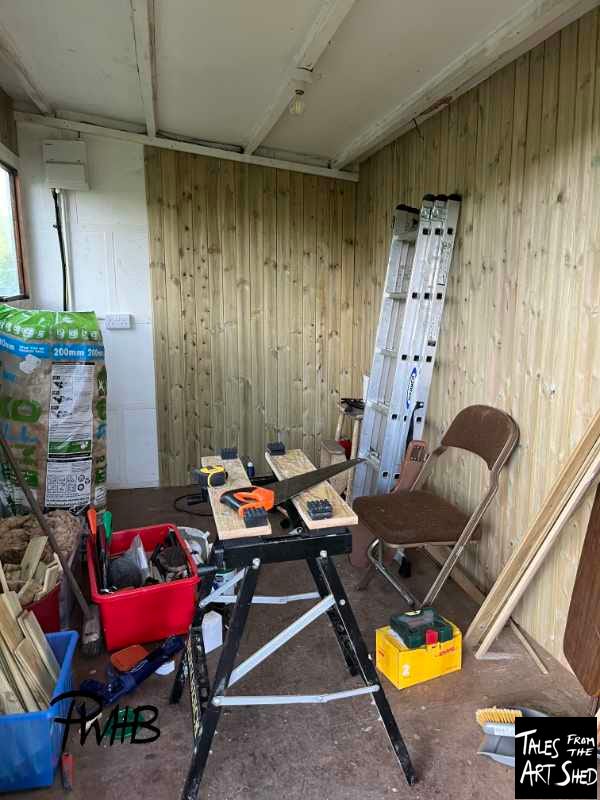
When I started tinkering about with arty things again I was just working at a table in my living room on small paintings, or doing a bit of drawing in a sketch pad. I set up an easel in my spare room but it was a nightmare having to work without freedom and contain my activities to one little area for fear of ruining the carpet. When the sun came out, I painted in the garden. That was okay for a bit but I craved a space of my own to get really messy.
Not many artists have a studio as chaotic and cluttered as Francis Bacon’s, a mirror of the twisted and distorted figures in his paintings. He once said, ‘I feel at home here in this chaos because the chaos suggests images to me’. Although he painted in several places over his life, his main and favourite was the studio at 7 Reece Mews, London (which some years after his death was sold, relocated and completely reconstructed at The Hugh Lane Gallery in Dublin). I was astonished to read the studio measured only 4 x 6 metres, double the size of my shed. Bacon was said to be very protective of his space and hardly let anybody in there while he was working. Looking at how cluttered it was I don’t think many others could easily have joined him.
A modern-day contemporary, the artist Rose Wylie, who at the age of 90 recently had a solo exhibition at the Royal Academy, works in her historic house in Kent. The rooms are littered with paint-covered newspaper that she uses to wipe her brushes, and over the period of making her art shrine-like mountains appear made of discarded paint pots (‘House and Garden’ magazine article). There’s some lovely photos of Rose Wylie’s studio in a post by the arts magazine ‘A Rabbit’s Foot’.
Although I love the romantic notion of these iconic messy artists’ studios, I know that trying to work in that kind of space would just be impossible for me. For one I don’t have as much room and I like to have free uncluttered surfaces to, well, clutter up! I need to have a space to put something down to dry. On a practical level, I hate stepping in wet paint, because there’s always a nightmare when going from the shed to the house (for essential tea and coffee breaks) without covering the floors in paint. And just to look around and see a mess everywhere, when my brain feels so much of a whirling mess anyway (yes, I have one of those brains), is disabling to my creativity. Reading this back though, my other half would probably disagree and say I do have a tendency to work in chaos. But I like to first clear a space to start a new project, get everything in order and put away or prepare work. Then, during the creation process, I like to make a mess, leave things here and there, don’t always tidy away, leave rags I use for painting hanging up or a few tissues here and there and wet paintings drying, but I would never let it get as messy (to me) as Bacon’s or Wylie’s studios. But then I’m not as good as those two amazing painters (both so different in styles) so maybe they are onto something!? I’m also a painter who likes to clean down my brushes as much as possible even if I’m planning to use them the next day. I like to then leave them out instead of packing them all away so I’m ready to get going straight away on the next session. Apparently, Rose Wylie just buys cheap ones and throws them away.
I also like the freedom a studio brings to make a mess if you want to or work more expressively so I could, for exampe, experiment with some Damien-Hirst-style spin paintings, or not have a heart attack when I spill half a tub of gesso (prep for a canvas) on the floor (like I did yesterday). If I’d done that in the house my other half would have moved all my clothes to the shed and changed the house locks.
A quiet space
I personally like to work alone, with the occasional pep talk with other artist friends or with my son on a phone or video call, or just have a day off to visit friends every so often. When I’m working I usually don’t want anybody else around so I can just concentrate without distraction. I just haven’t got the ability to work very effectively with other people around; if they are, I have to drown them out with headphones. Probably another reason I’ve not done a proper office job for years. I do miss the banter and human contact, so, to not feel so lonely (as artist John Hoyland once remarked), I listen to the radio, or spoken word, audiobooks or podcasts.
I recently visited some artists at a communal art space for their Open Studios, where they have up to 50 artists, which does sound fun, but also a bit of a nightmare for me. That’ll be the subject of a future post; for now it’s just me on my tod, in a shed, painting.
Of course if you have a place to call your own it doesn’t have to be peaceful. I often play loud music, on repeat.
A serious space
I did secretly take offence when a few people remarked after seeing my newly-kitted-out shed that I’d just created a ‘man cave’, but as mentioned previously I had then dared not admitted that I was seriously going to create an art studio because it felt too… serious.
There’s a sense that when you get your first studio (or a shed with serious studio aspirations) you have ‘arrived’. You’ve taken another step closer to developing as an artist. And to be clear, I don’t feel that having a shed decked-out as an art studio at the bottom of my garden makes me feel like I’ve ‘arrived’, perhaps because of already mentioned imposter syndrome, but moreover I’ve not had to take the big financial decision to pay for a ‘real’ studio space outside of my house, which I’m sure you have to do when you get some success from your art and need space to produce higher volume and larger work. But then I still think what I have is wonderful. I know I’m lucky to have the space, a space that has enabled me to take myself a bit more seriously, and focus on developing my own regular art practice.
The problem with having a dedicated space — whisper it, ‘a studio’ — is that I can often have an overwhelming pressure to now create ‘art’, in the same way one might get a writing room all ready with a shiny new typewriter (okay, it was a laptop) that goads you into writing the next great literary masterpiece. The pressure to create a work of art to show family and friends to justify the effort and expense of creating a dedicated work space, a studio, can be debilitating. It didn’t take my other half very long to realise that a normal creative day for me involves hours of staring and pacing before finally removing more marks from the canvas than I’ve put on. In fact often that can actually be quite a successful day, artistically.
My space (not that retro social network)
My little shed is a physical space, a work space, a safe space, a messy space, a quiet space (occasionally a noisy drum ‘n’ bass space), a serious space.
And it’s my space.
I hope, like me, you can find a space to create and one day call it your studio.
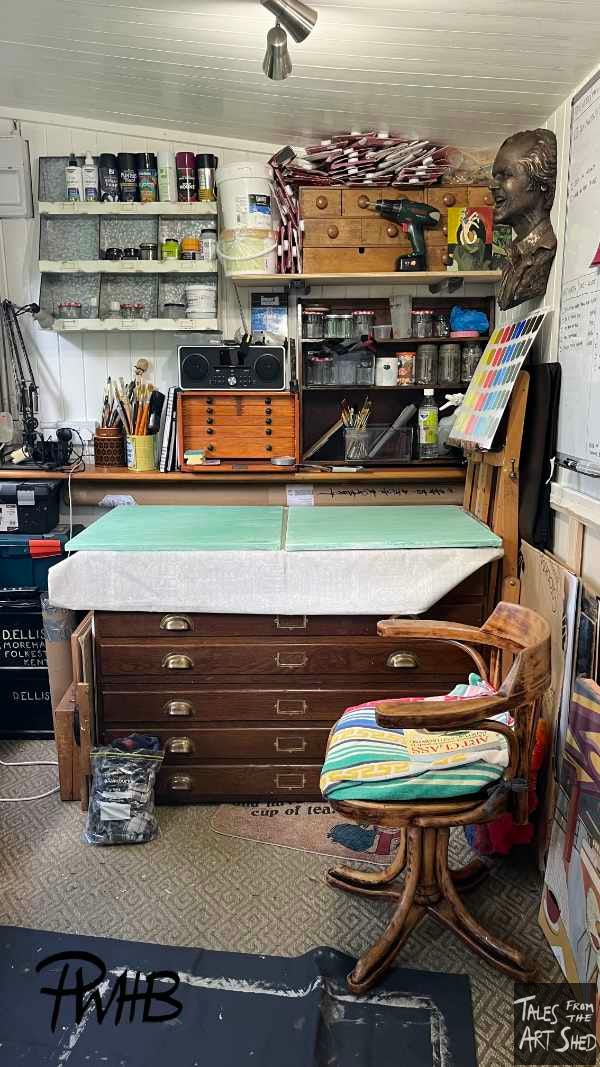
Great work Phil! the studio is looking great - love that final photo. You're right - now we've made these studio spaces for ourselves, we need to get on and make stuff! see you in Newlyn
Does an artist need a studio? Does a writer need a writing room? I think so. Read about how I turned a rotting shed at the bottom of my garden into an artist’s studio. But I still call it a shed.